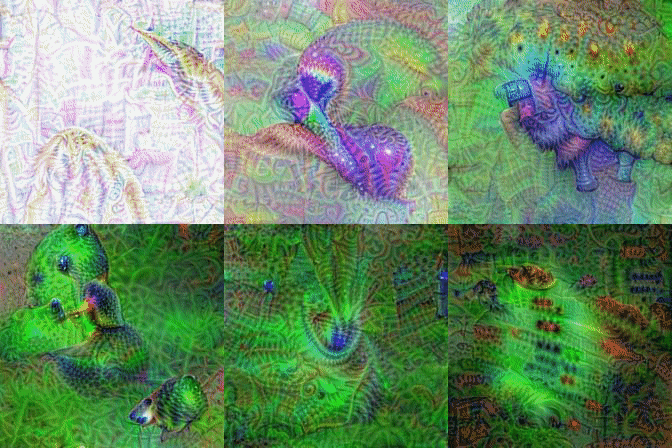
Here are all 1000 classes in the ImageNet challenge, rendered with the Visual Geometry Group's 19-layer neural net, using the same deepdraw technique I used for the thousand faces of CaffeNet. These ones are rendered on random grayscale noise, not my face.
This is the net which the neuralgae Twitter …
more ...If you don’t like the state (read: if you don’t like paying taxes or welfare) its backing of money will seem monstrous to you. Returing to a real physical substance as a store of value is politically infeasible because we know what the banking system was like in …
more ...MWHALE IN THE WHALE AND BERED OF THE WHALE IN THE WHALE.
"The whale seemed the ship had been the side of the stranger of the ship would be seen the artain in the sea, and the whale was the ship was a sudden and sounding and head of the …
more ...The fourth and last in a series of posts about how we think about coding and functional programming. The first three are The Homunculus, State and Immutable and pure
An algorithm is a procedure or formula for calculating a result, an idea which predates the invention of the computer by …
more ...The third in a series of posts about how we think about coding and functional programming. The first was The Homunculus and the second was State
The subsections of programs referred to in the previous section are often called functions. In mathematics, the term function has a fairly strict definition …
more ...The second in a series of posts about how we think about coding and functional programming. The first was The Homunculus
Even though I've complained about the metaphor of the homunculus, it can be used as a useful device to explain the differences between programming paradigms to a non-technical audience …
more ...Here are visualisations of the 205 scene categories in the MIT Places Database using a variant of the same technique used to generate the thousand faces of Caffenet.
These are rendered on random grayscale noise rather than a photograph, so they're purely a manifestation of what the neural net has …
more ...Here are the thousand image categories in the ImageNet Challenge data visualisation context, rendered onto a webcam photo of me using the deepdraw technique.
This is the set of image classifications which the standard Deepdreams imagery is based on: as more than one hundred of the categories are dog breeds …
more ...This is the first in a series of posts about the way we think about programming, the influence these ideas have on how we write code and what languages we choose, and why I like the functional programming paradigm in general and Haskell in particular.
Consumer notification: I've worked as …
more ...